

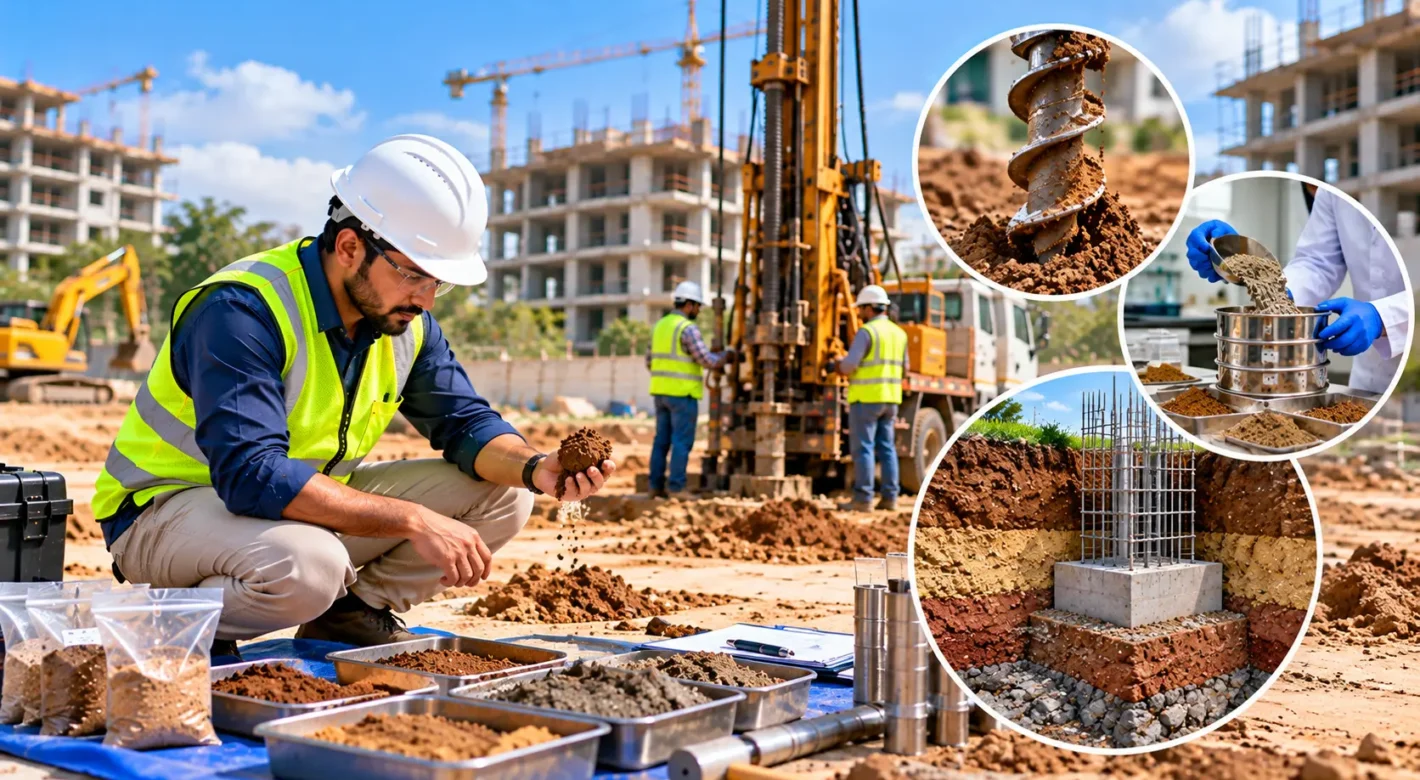
Before starting construction, one important question needs to be answered: is the ground suitable for the proposed building? Soil conditions can influence foundation selection, settlement behaviour, and construction planning. That is why professional soil testing in Bangalore is an important step for residential, commercial, industrial, and infrastructure projects.
Whether you are planning an independent house, an apartment building, a commercial complex, or an industrial facility, understanding the soil beneath your site can help engineers make informed foundation decisions.
ACT Laboratory provides soil testing and related civil engineering testing services to support construction projects across Bangalore and Karnataka. In this guide, we explain the soil testing process, factors affecting cost, common tests, and the benefits of a site-specific investigation.
What Is Soil Testing and Why Is It Important Before Construction?
Soil testing is the process of examining soil properties through suitable field investigations and laboratory tests. The results help engineers understand the ground conditions relevant to a proposed structure.
A soil testing laboratory in Bangalore may conduct or coordinate different tests depending on the project requirements, site conditions, and investigation scope.
For construction projects, soil testing can help determine:
- Soil classification and relevant physical properties.
- Soil bearing capacity and foundation-related parameters.
- Soil strength and compaction characteristics.
- Moisture conditions and other relevant geotechnical properties.
- Whether additional investigation is required before foundation design.
The required tests vary from site to site. A small residential plot and a multi-stores commercial building may need different investigation scopes because their loads, foundation requirements, and ground conditions can differ.
For this reason, soil testing should be planned around the proposed structure rather than relying only on general assumptions about the area.
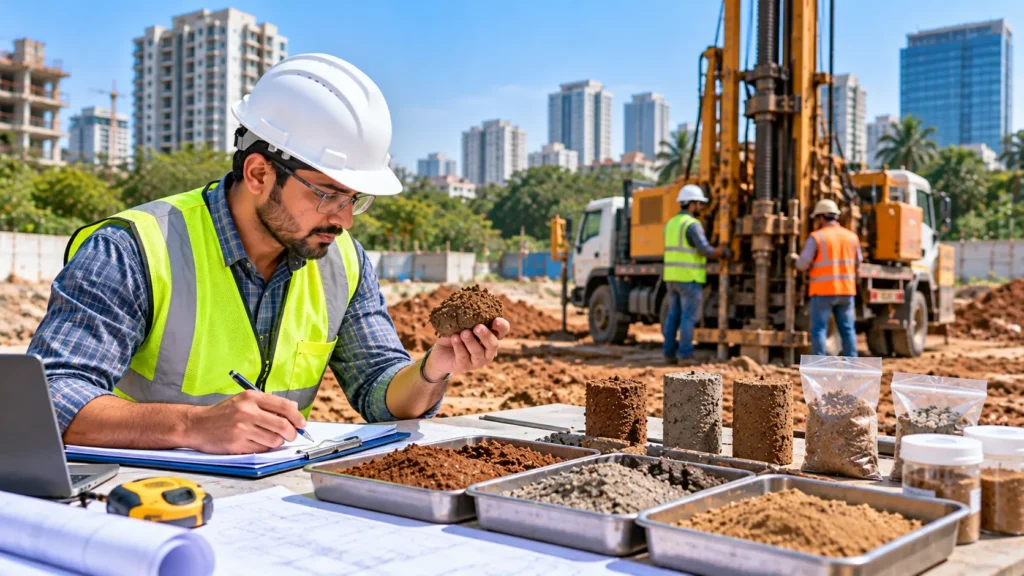
How Much Does Soil Testing Cost in Bangalore?
One of the most common questions property owners ask is, “What is the cost of soil testing in Bangalore?”
There is no single price that applies to every construction site. The total cost depends on the investigation required, the number of test locations, the depth of exploration, site accessibility, equipment requirements, laboratory tests, and the final reporting scope.
Factors That Affect Soil Testing Cost:
1. Site location and accessibility
The location of the property, access for drilling equipment, and site conditions can affect mobilization and investigation costs.
2. Number of boreholes and investigation depth
The location of the property, access for drilling equipment, and site conditions can affect mobilization and investigation costs.
3. Site location and accessibility
The location of the property, access for drilling equipment, and site conditions can affect mobilization and investigation costs.
4. Site location and accessibility
The location of the property, access for drilling equipment, and site conditions can affect mobilization and investigation costs.
5. Site location and accessibility
The location of the property, access for drilling equipment, and site conditions can affect mobilization and investigation costs.
How to Get an Accurate Soil Testing Quote
To obtain a suitable quotation from a soil testing laboratory in Bangalore, share the following details:
- Project location and site dimensions.
- Proposed building type and number of floors, if known.
- Available architectural or structural drawings.
- Any specific tests or geotechnical investigation requirements.
- Site access details and preferred investigation schedule.
ACT Laboratory can discuss your requirements and help identify the appropriate scope for your project. Request a project-specific quotation rather than relying on a generic online price.
What Is the Soil Testing Process for Construction?
The soil investigation process depends on the project, but it generally involves the following stages.
Step 1: Site assessment and investigation planning
The project requirements, site conditions, proposed structure, and available drawings are reviewed to establish an appropriate investigation scope.
Step 2: Field investigation and soil sampling
Depending on the investigation plan, fieldwork may involve borehole drilling, in-situ testing, and collecting representative soil samples from selected depths.
Step 3: Laboratory soil testing
Suitable laboratory tests are performed to evaluate relevant soil properties. The selected tests depend on the samples, ground conditions, and engineering objectives.
Step 4: Technical analysis and reporting
Field observations and laboratory results are compiled and interpreted as required by the project. The report can provide information for geotechnical evaluation and foundation design.
The number of field visits, laboratory tests, and reporting stages depends on the project. Confirm the expected completion schedule with the laboratory before work begins.
Common Soil Tests for Building Construction
The right combination of tests depends on the ground conditions and the type of structure. The following are some commonly used tests in geotechnical investigation.
1. Standard Penetration Test (SPT)
An in-situ test used to obtain penetration resistance information at selected depths during a borehole investigation. Results help assess subsurface conditions.
2. Soil Bearing Capacity Testing (SBC)
Helps assess soil support characteristics for foundation-related engineering decisions. The appropriate method depends on the site and investigation objectives.
3. Soil Classification Test
Evaluates soil characteristics used to classify the material and understand its engineering behaviour.
4. Soil Compaction and Field Density Testing
Used where required to assess compaction characteristics or verify the density achieved in prepared soil and fill layers.
5. California Bearing Ratio (CBR) Test
Evaluates the strength of compacted soil or sub-grade material for applications such as road and pavement design.
6. Soil Moisture and Physical Property Tests
Tests such as moisture content, particle-size distribution, and consistency limits can help characterize soil, depending on its type and intended use.
Not every construction project requires every test. A qualified geotechnical professional should determine the appropriate investigation and testing scope.
Benefits of Soil Testing Before Construction
Investing in suitable soil testing before construction can provide several practical benefits.
- Supports Foundation Planning: Soil investigation provides information that engineers can use when evaluating suitable foundation options and design parameters.
- Helps Identify Unfavourable Ground Conditions: Testing can reveal variations in soil properties and identify conditions that may require additional investigation or specific engineering measures.
- Supports Settlement Assessment: Relevant geotechnical data helps engineers evaluate potential settlement and other ground-related considerations for the proposed structure.
- Improves Construction Planning: Understanding subsurface conditions early can help project teams plan excavation, ground preparation, and foundation-related activities more effectively.
- Helps Manage Uncertainty and Costs: Identifying ground-related concerns before foundation work begins can reduce the risk of unexpected changes, avoidable delays, and costly corrective measures.
Soil testing does not guarantee that construction problems will never occur. Its value lies in providing site-specific information to support informed engineering decisions.
Why Are Site-Specific Soil Testing Services Important in Bangalore?
Bangalore has a mix of developed urban areas, expanding residential layouts, commercial developments, and industrial sites. Ground conditions can vary between locations and even across different parts of an individual property.
A site in Whitefield may not have the same subsurface conditions as a site in Yelahanka, Sarjapura, Hebbal, or Kengeri. Surface appearance alone cannot establish the properties of the soil beneath the proposed foundation.
This is why soil investigation in Bangalore should be planned for the actual construction site rather than based only on nearby properties or general assumptions about the locality.
For example, some sites may contain clayey soil, while others may have sandy soil, weathered material, or rock at varying depths. Groundwater conditions and changes between soil layers may also affect the investigation requirements.
A site-specific geotechnical investigation helps engineers evaluate the relevant conditions and determine what additional testing or analysis may be necessary.
How to Choose the Right Soil Testing Laboratory in Bangalore
Before selecting a laboratory, consider these important points.
- Relevant testing capabilities: Confirm whether the laboratory can perform or coordinate the tests required for your project.
- Clear scope of work: Understand which field investigations, laboratory tests, and reporting services are included in the quotation.
- Suitable technical expertise: Ask who will interpret the results and how the findings will support your project requirements.
- Applicable standards: Confirm that the testing procedures follow the relevant project specifications and applicable standards.
- Clear documentation: Check what information will be included in the final soil test report.
- Transparent pricing: Compare quotations based on the same investigation scope, not just the total price.
If you need a Soil Testing Laboratory in Bangalore, choose a provider based on the suitability of its services for your project rather than price alone.
Why Choose ACT Laboratory for Soil Testing in Bangalore?
ACT Laboratory provides civil engineering testing services for construction-related projects across Bangalore and Karnataka.
Our Soil Testing services are relevant to clients who need technical information about site conditions and geotechnical properties for project planning.
Depending on the agreed scope, soil testing and investigation requirements may involve:
- Soil classification and physical property testing.
- Soil bearing capacity assessment and related investigations.
- Geotechnical investigation for building projects.
- Appropriate field and laboratory testing.
- Technical documentation to support engineering evaluation.
Whether you are planning a residential house, a commercial building, or an industrial facility, the first step is to identify the testing requirements for your particular site.
Looking for Soil Testing Services in Bangalore? Contact ACT Laboratory to discuss your project location, proposed building, and investigation needs.
Frequently Asked Questions About Building Material Testing
1. What is the cost of soil testing in Bangalore?
The cost depends on the number of investigation points, drilling depth, site accessibility, required field and laboratory tests, and reporting scope. Contact a laboratory with your project details to obtain a suitable quotation.
2. Is soil testing necessary for house construction?
Soil testing is an important part of informed foundation planning. The appropriate investigation depends on the proposed building, site conditions, engineering requirements, and applicable local rules.
3. How long does soil testing take?
The duration depends on the investigation scope, fieldwork requirements, laboratory tests, and report preparation. Ask the testing provider for an estimated schedule based on your project.
4. What is SBC testing?
SBC refers to soil bearing capacity. SBC testing or assessment helps engineers evaluate the ground’s ability to support foundation loads using appropriate methods and geotechnical information.
5. What is included in a soil test report?
Depending on the scope, a soil test report may include field observations, borehole logs, laboratory test results, soil classification, relevant geotechnical parameters, and engineering recommendations where included in the agreed service.
6. Can I use a neighboring property’s soil test report?
A neighboring report should not automatically be treated as representative of your site. Soil conditions, building loads, foundation levels, and investigation depths can differ. Your geotechnical engineer should determine whether separate site-specific investigation is required.
7. Which soil tests are required for a commercial building?
The required tests depend on the building’s size, loads, foundation system, ground conditions, and design requirements. A geotechnical professional should define the investigation scope for the proposed project.
8. Where can I find soil testing services in Bangalore?
Look for a civil engineering testing laboratory that can address your project’s geotechnical requirements, explain its testing scope, and provide suitable technical documentation. ACT Laboratory can discuss your soil testing requirements for projects in Bangalore and Karnataka.